Misinformation is hard to fight because simply knowing misinformation exists doesn’t teach someone how to spot it. Two tools, Rumor Guard and Bad News, approach the problem of misinformation differently. After exploring them, I think both are useful, but neither can solve the problem of misinformation entirely.
Rumor Guard
RumorGuard, created by the News Literacy Project, uses actual viral misinformation to teach people how to evaluate information online. Instead of simply labeling something “false,” RumorGuard walks users through why a claim should not be trusted. Its framework focuses on five factors: source, evidence, context, reasoning, and authenticity. Individual examples show a viral claim and explain which factors caused it to fail a credibility check.
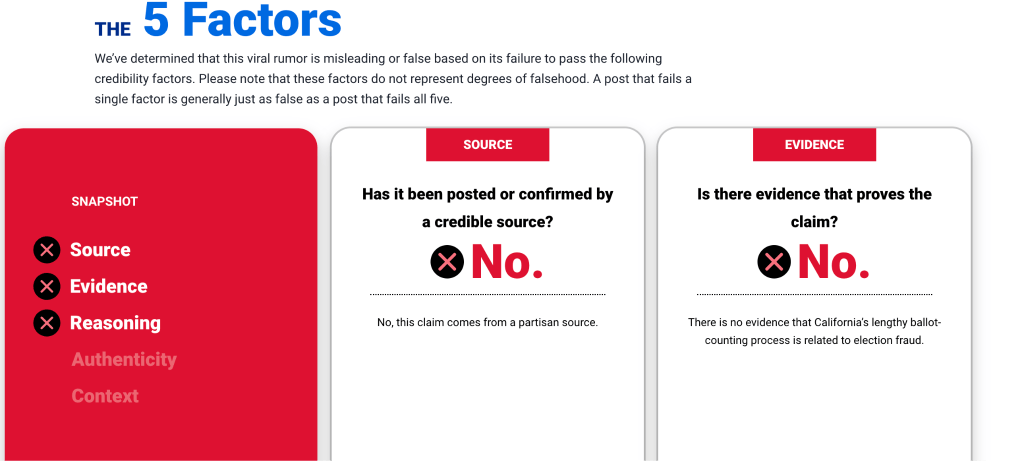
I found this approach effective because it teaches skills that can transfer to other situations. For example, users learn to investigate the original source of an image, search for credible reporting, perform reverse-image searches, and determine whether content has been removed from its original context. One RumorGuard example involving an altered video demonstrates the importance of locating original footage rather than trusting a short social-media clip. This encourages people to ask how do I know this is true? rather than simply accepting or rejecting information based on whether they agree with it.
A limitation, however, is that RumorGuard provides the investigation and conclusion for you. Reading completed fact-checks is different from independently investigating a new claim. Still, I think its use of real misinformation makes the lessons practical and memorable.
Bad News takes almost the opposite approach. Instead of becoming a fact-checker, the player becomes a misinformation creator whose goal is to gain followers while maintaining enough credibility to remain influential. The game introduces six common manipulation strategies: impersonation, emotion, polarization, conspiracy, discredit and trolling.

I especially liked this approach because it demonstrates that misinformation is not always just an incorrect fact. Successful misinformation can exploit emotions, identities, distrust, and existing divisions. Having to make these choices yourself makes the manipulation strategies much easier to recognize afterward. The game is based on inoculation theory, which proposes that exposing people to weakened examples of misleading arguments and explaining their techniques can increase resistance when they encounter actual misinformation later. Research on misinformation inoculation provides evidence that preemptive media-literacy interventions can reduce susceptibility to misinformation.
There are limitations. The exaggerated and humorous scenarios can make misinformation production seem simpler than it actually is, and recognizing a technique in a game does not guarantee that someone will recognize it when a real post confirms their existing beliefs.
Overall, I think interactive tools are valuable because they turn media literacy from something people read about into something they practice. RumorGuard emphasizes verification, while Bad News emphasizes manipulation techniques. Used together, they show both sides of the misinformation process. Games alone will not eradicate misinformation, but they can give people practical habits and a healthier skepticism toward what appears in their feeds.


Leave a Reply