Greenwashing is a misinformation-related marketing practice in which a company makes its products, policies, or overall environmental impact appear more responsible than the available evidence supports. It often works through implication rather than a completely fabricated statement. A package may use leaves, forests, green colors, environmental symbols, or vague words such as “natural” and “sustainable,” creating an impression that is stronger than the specific claim being made. According to the United Nations, greenwashing misleads the public into believing that an organization is doing more to protect the environment than it actually is, distracting attention from concrete environmental action.
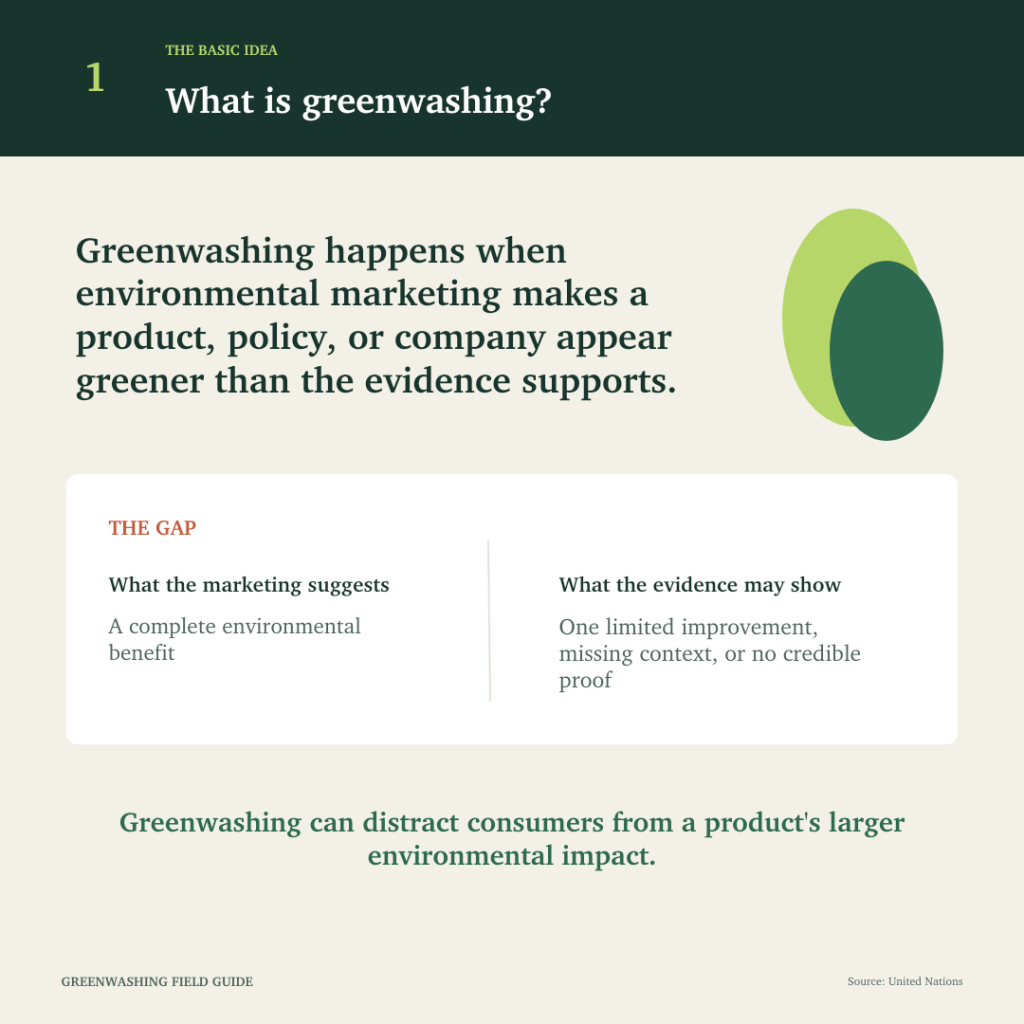
The first graphic introduces greenwashing by emphasizing the gap between appearance and evidence. Greenwashing does not require every part of an environmental claim to be false. A company may identify one positive feature while leaving out conditions, limitations, or larger environmental consequences. Ultimately, the incomplete presentation can influence a consumer in the same way as a directly false statement because the audience receives an inaccurate understanding of the product’s overall impact.
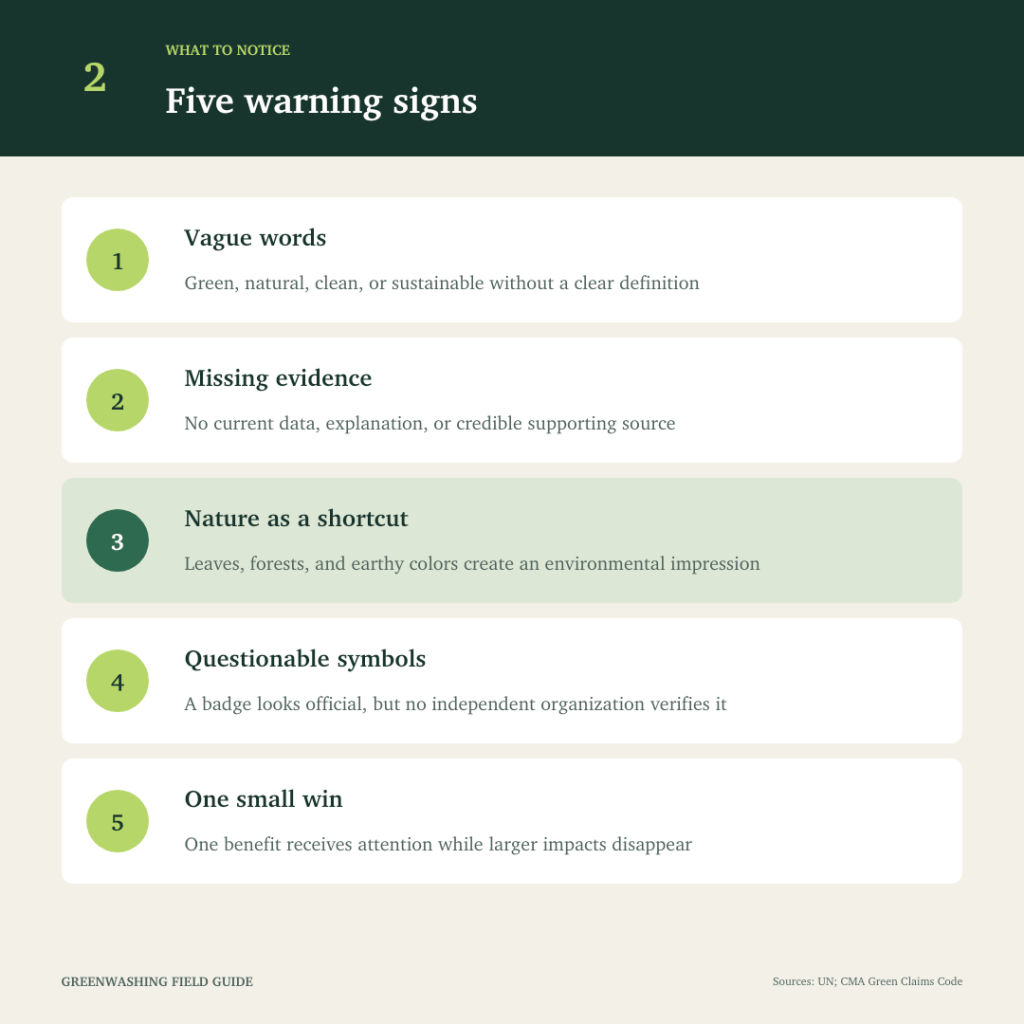
The second graphic identifies five warning signs that frequently appear in environmental marketing. Vague language is important because terms such as “eco-friendly” can create a broad impression without explaining what changed or how the benefit was measured. A claim should have current, credible evidence and should clearly describe whether it applies to the entire product or only one feature. The UK Competition and Markets Authority’s Green Claims Code states that environmental claims should be clear, accurate, supported by evidence, and should not omit information that changes the overall meaning. The same guidance asks companies to consider the product’s full life cycle instead of focusing only on its most favorable feature.
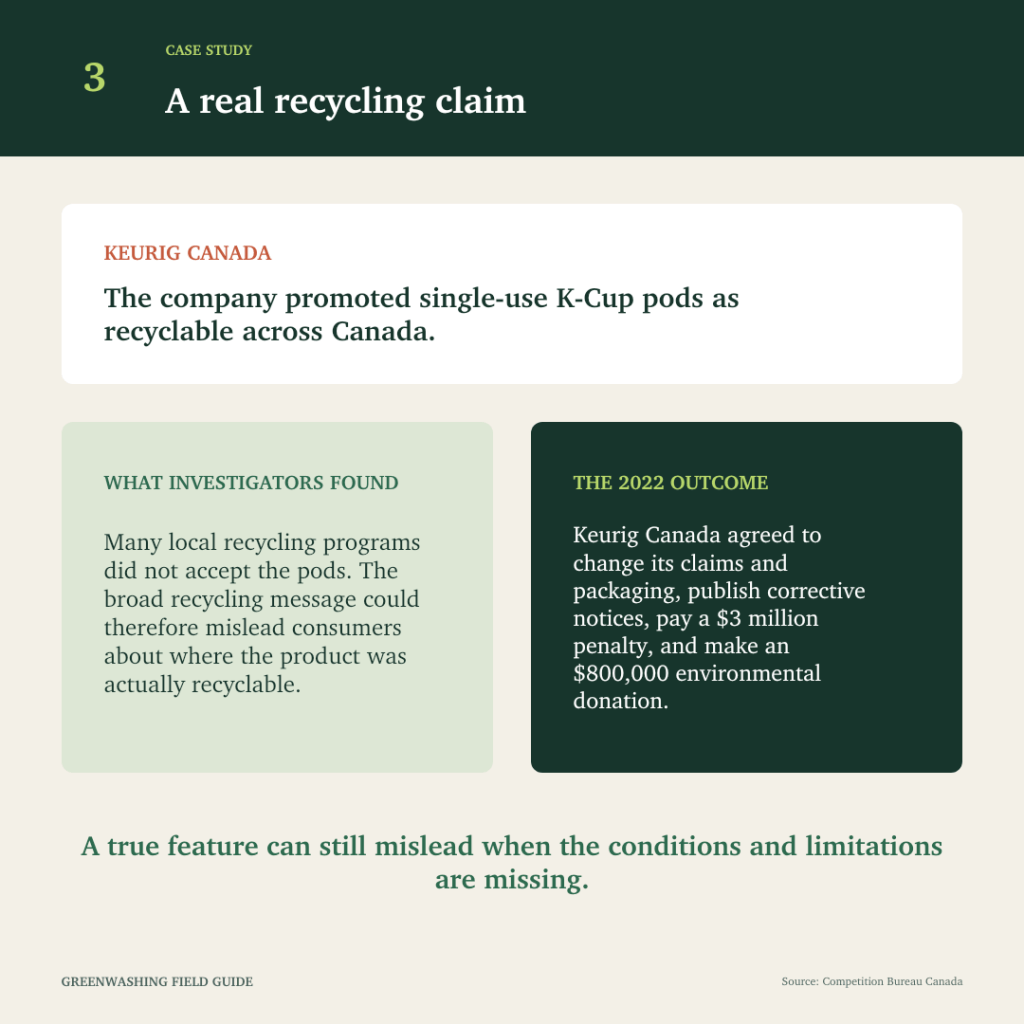
The third graphic uses Keurig Canada as an example of how a technically limited environmental feature can become a misleading marketing message. In 2022, Canada’s Competition Bureau reached an agreement with the company concerning claims about the recyclability of single-use K-Cup pods. The Competition Bureau concluded that the claims were false or misleading in locations where local recycling programs did not accept the pods. Keurig Canada agreed to change the claims and packaging, publish corrective notices, pay a $3 million penalty, and donate $800,000 to an environmental charity. The case illustrates how the word “recyclable” may be misleading when consumers lack the facilities or programs required to recycle the product in practice.
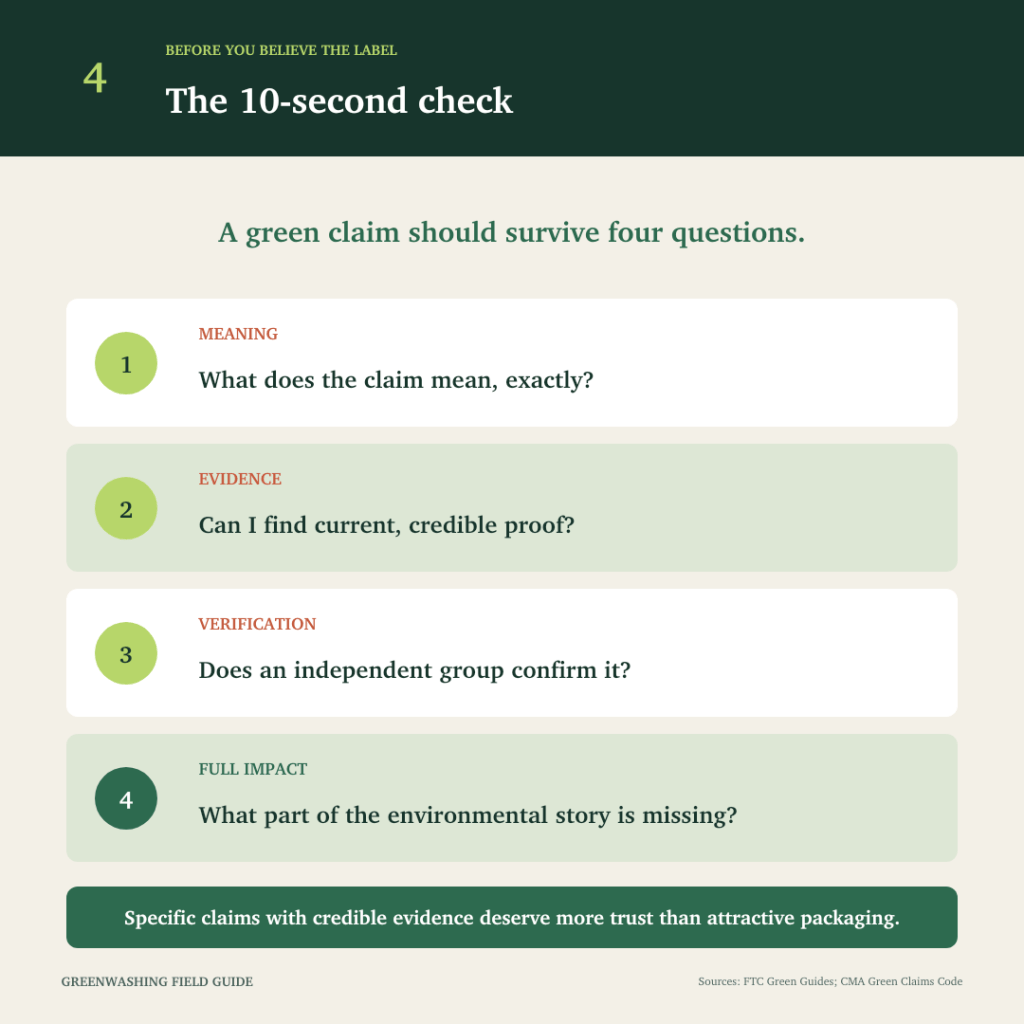
The final graphic gives viewers a short process they can use while shopping. First, they should identify exactly what the claim promises. Second, they should look for recent and credible evidence. Third, they should determine whether an independent organization verifies a certification or symbol. Finally, they should consider what part of the product’s environmental impact the advertisement leaves out. The Federal Trade Commission’s Green Guides similarly advise marketers to support environmental claims and qualify them so consumers are not deceived. While consumers should not have to investigate every word printed on a package, these questions can prevent attractive design from replacing evidence.
Because these claims frequently appear beside ordinary product information, consumers may treat them as facts rather than advertising choices, allowing an attractive environmental identity to influence purchasing decisions before the supporting evidence has been examined.
Clearly, greenwashing works because it connects environmental concern to the ordinary process of purchasing products. Many consumers want to make responsible choices, but they may only have a few seconds to evaluate a label, advertisement, or sponsored social media post. These graphics do not attempt to tell viewers which companies they should support. Instead, they provide a media-literacy method that viewers can apply to environmental claims for themselves. Ultimately, a credible green claim should be specific, supported, independently verifiable when possible, and honest about its limitations.
Audience and approach
The specific audience for this project is college students between the ages of 18 and 25 who care about environmental issues and encounter product advertising through social media, online shopping, influencers, and physical packaging. I chose this audience because young consumers may want to make sustainable choices while having limited time to investigate every environmental claim they see.
I chose a four-part social media graphic series because greenwashing is a visual form of misinformation. Colors, symbols, photographs, packaging, and short claims shape the audience’s interpretation before they investigate the evidence. The graphics use the same compact format as the advertisements they are teaching viewers to question, while the accompanying blog text provides the research and explanation that cannot fit into a single image.
References
Competition and Markets Authority. (2021). Green Claims Code: Making environmental claims.
Competition Bureau Canada. (2022). Keurig Canada recycling claims case.
Federal Trade Commission. Green Guides.
United Nations. Greenwashing: The deceptive tactics behind environmental claims.


Leave a Reply